Layer It On

Art is a progressive act. No matter how angry or dark the subject, the act of creating and expressing is by nature optimistic, a call for connection and a search for understanding.

What’s especially exciting to me lately, then, is the layering of interpretations that can take place, as an original production gets remade, or dancers choreograph to a new song, or a book gets adapted for the screen. Expression on expression, the conversations between artists that span time periods, geographical space, and art forms.

One particularly entertaining example came last week, when U.S. figure skater Jason Brown performed to Hamilton’s The Room Where It Happened. Not only did he perform flawlessly for a full rink of fans, his performance made it to Lin-Manuel Miranda’s living room (Miranda wrote Hamilton). Surprise and delight travels well.

The other day I rewatched Joss Whedon’s version of Much Ado About Nothing, easily one of my favorite movies. Filmed in one house, over a weekend (so the legend goes), this production is visually gorgeous and also just the right combo of traditional and modern so that the audience will actually understand Shakespeare’s language. I repeat: when I watch this movie, I actually get what Shakespeare meant. The reinterpretation not only created a stunning production, but it also shone a light on Shakespeare’s timeless artistry. The layers work together to make both the original and the reinterpretation better.

Admittedly, maybe I’m thinking about layers so much simply because it’s freezing in New England and I’m wearing about twelve layers all the time. But I think it has more to do with the power that art provides for us to learn from one another and create in concert with those who came before and will come after us. A generational conversation about things that matter, in ways that we can understand.

Here’s the thing about interpretation, though: no one need wait to put their own spin on things. You do not need credentials to become part of the discussion (anyone who’s created dance routines to Whitney Houston can vouch for this). The discussion happens with every moment of appreciation and every act of production.

You are just as capable of interpreting the art that you see, of riffing off of a story that inspires you. As long as you are not ripping off someone else’s work, your engagement with the art is part of the process, and part of our progress as people.

For some people, engaging with art will inspire them to do something progressive in the political arena, to make phone calls to elected officials, volunteer in their community, or see someone’s experience a little differently. For others, it will inspire them to create more art.

Whatever your inspiration, whatever your medium, don’t shy away from engaging with the art around you. You just never know what it will inspire. Layer it on.
 

The Quest to be Known

The best characters have quirks, flaws, and many facets. So why do we spend so much time in real life hiding these very things?

Writing teachers will always push their students to come up with details that make their characters human. One of the standard tips is to give a character a habit – the quirkier the better. If at first go, the character bites her nails, is there something different she could do that’s even more interesting?

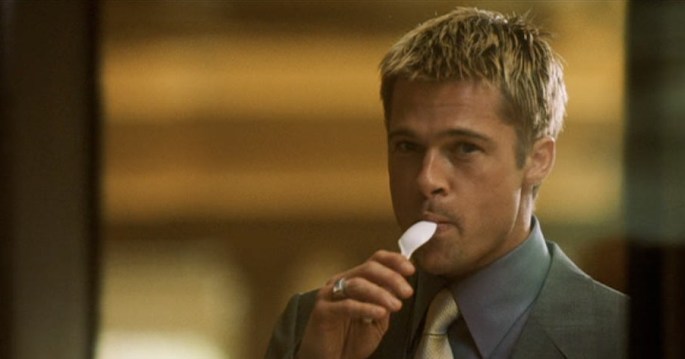
One of my favorite examples is Brad Pitt’s character in Ocean’s Eleven (the whole series, really). That man is always eating. Every scene. No matter what time of day. Almost always messy snacks. I love him all the more for it — in large part, because I feel like I know him a little better.

All of us yearn to be known. We yearn to be understood as whole people, complete with mismatched parts, strange quirks, and many layers. But then we try never to show our bad habits, our guilty pleasures, our odd hangups.

And we wonder why we don’t feel like people know the real us?

A friend told me recently about an experience that touched him deeply, where he got to combine two disparate parts of his life and connect with others that shared the connection. He delighted in the experience, and it also left him feeling a bit emotional. I suspect that he was feeling closer to known — fully and completely.

If you find yourself wishing to be known, if you recognize that you are feeling disconnected, here’s an idea. The next time you’re having a good conversation with someone, see if you can reveal just a little insight into yourself you wouldn’t normally share. See if you can be just a little more honest — with a coworker, a friend, your mailman.

They might just be happy for a window into the real you. And maybe, someday, they will really, truly know you, too.


Worthy

I’ve been part of an interesting online discussion among aspiring writers, who have been asking, “Is my story worthy of being told?”

It’s essentially an immaterial question for those of us who write for life. Much as I would like to publish and share my writing, that’s not its true function.

A natural answer might be, “Everyone’s story is worthy of being told.” I believe this to be true. Transformation happens when each of us discovers a true voice and the best means of personal expression (whether in an area we officially recognize as “Art” or in doodles or excel spreadsheets or whatever).

But what happens when some stories have been heard, and heard, and heard some more?

It’s our responsibility to make sure that the stories that haven’t been told get told.

It’s our responsibility to raise up and celebrate stories, and to shine a special spotlight on those that haven’t been told often, well or authentically.

Here are a few of my favorite discoveries of late:

  • At a recent Slice Magazine writers’ conference, I was introduced to four amazing poets, whose stories, work and experiences I can’t stop revisiting: Javier Zamora, a Salvadoran-born poet; Hafizah Geter, born in Nigeria; Ricardo Alberto Maldonado, born and raised in Puerto Rico; and Jenny Xie, who moved to the U.S. from China as a child. The panel was focused on how these impressive artists explore their past and heritage in their work, hence why I have highlighted their heritage in this short paragraph. Its not fair, because I should take the space to list each of their extensive accomplishments, because they are formidable poets grappling with important, complex issues. So, there’s your homework – read these poets. They are impressive.
  • Tchaiko Omawale, an independent filmmaker, is in the finishing stages of fundraising for her feature film, Solace, based on her personal story. It promises to be amazing. Check out the trailer.
  • Becoming Nicole: The Transformation of an American Family is a story we should all spend time with. From a very young age, Nicole (born Wyatt) knew she was a “boy-girl,” different from her twin brother. Thanks to support from her mother, eventually her father, and an extended fight for her rights, Nicole was able to realize her true identity.  This book should mark a journey toward empathy and understanding for those who are interested but uninformed about transgender rights, realities and public reaction.
  • Lest we leave the babies out, Roseanne Thong has written children’s books with a unique approach to the old standards. Two stand-outs are: Round is a Mooncake (a book of shapes) and Green is a Chile Pepper (focused on colors). Since I am probably buying more baby presents than anything else right now, I have taken an interest in writers of children’s books with a unique perspective.

Every story is important. Every story can lift us up, whether we relate directly to a particular issue or whether we relate just as one human to another. Every story should be told, and anyone with an urge to create should do so.

But when we see that some stories aren’t getting the press they deserve, that people are not accessing the unique perspectives that enrich our lives, we should speak up. This is a really short list.  Who would you like to lift up?


Look Twice

Moonlight grabbed me from the first I heard of it. An online description summarized it as follows: “A young man deals with his dysfunctional home life and comes of age in Miami during the ‘War on Drugs’ era.”

Given all my recent learning about mass incarceration, race and the impact of the War on Drugs,* I was all in to see this story take shape. Before it came to Hartford, I took a drive to Boston just for Moonlight.

It was so much more than any one sentence can summarize.

Moonlight is the story of Chiron over three stages of his life, as a kid, teenager and young man. As a kid, he doesn’t fit in, and he’s on his own a lot. His mom works hard and struggles with a drug addiction. It’s a story of disconnection and connection. Chiron meets good people who care about him and betray him, who he loves and wishes he didn’t. Drugs and the drug trade are a constant thread, a ticket to survival and destruction all at once.

I could watch Chiron’s story again and again, to take in the nuance and appreciate its many layers. It’s a story that resists easy summary, multifaceted and true to life. I was amazed by how well done it was.

There was just one thing that didn’t make sense to me. The poster. It seemed so basic. Just a picture of a face in the moonlight. I felt that it didn’t do justice to the story.

Then I looked at it again.

I had missed the nuance completely. I had looked too quickly, and hadn’t noticed that the poster was three faces spliced together, each with a different purplish hue to represent a phase in Chiron’s life. It was a story of three people in one, a picture of transformation embodied.

I was wrong. The poster was perfect. I just had to look more closely.

It got me thinking. What else had I missed? When else have I glanced too quickly, and missed the layers of meaning? What else had I not noticed?

After that, I renewed my commitment to noticing. To paying attention. To looking twice.

Because art, as in life, is all about the layers. How could I have missed that?

*If you haven’t seen Ava DuVernay’s 13th on Netflix or read The New Jim Crow by Michelle Alexander, make sure you add them to your list. There’s so much more but these two are really powerful and chock full of important information.

What About You?

I saw La La Land recently. True confession? I didn’t love it. I appreciated it and the movie tradition it was referencing, and its theme certainly appealed. I was drawn in by the ending. But in all honesty, it wasn’t my jam.

The friend I saw it with, though, loved it. She was thoroughly mesmerized.

That means I’m not done with La La Land yet. I have to find out what about it captured her. After our conversation, I’ll know more about my friend, and I’ll also appreciate the movie a little more.

The exchange is the magic. Art is as much about what it does for us, as it is what it tells us about ourselves and the experience of others. When we understand what moves others, or why something doesn’t move us, we get closer to true connection.

Every exchange is worth it. Every experience of art – good, bad or indifferent – is valuable for that reason alone. In fact, good, bad or indifferent doesn’t matter as much as what happens after that.

A simple question will help: What about you?

Because we’ll get to understanding one another much faster with that question than we will by shouting our own opinions from the rooftops.