
Why I Coach

“If I could only do one thing to help nonprofits, I would get every executive director a coach.”

This comment from a foundation colleague in January 2018 set me on an unexpected path — first to understand why coaching can be so effective, then to explore what coaching is, and finally to dedicate myself wholeheartedly to serving as a coach for nonprofit executives and philanthropists.

In short, I believe coaching is one of the best ways to move us from ideas to action.

Most of the time, what holds us back is not our good intentions. Especially in social change work, we have the best of intentions. What holds us back is all of the other stuff (yes, the technical term) that goes into our daily choices — our assumptions about ourselves and others, our motivations, the practical necessities and the barriers (often self-imposed) that stand in our way.

Coaching clears the clutter and addresses each person’s individual needs.

Coaching empowers individuals. Coaching reminds each one of us of the choices we make every day, and of our opportunity to flip the script.

When you experience masterful coaching, it feels like magic. Suddenly, worlds open up. Opportunities make themselves known.

Ok, cynics, I hear you…You’re right, coaching is not magic. It’s about asking good questions and keeping the person being coached in the power seat. It’s about that person owning her own transformation or change — the coach uses a variety of techniques, built on non-judgment and curiosity, to encourage that ownership.

Coaching is not therapy, but sometimes it feels therapeutic. If someone holds deep trauma and needs healing, she should go to therapy. But coaching is psychological and definitely unlocks emotions and triggers, but with a lens towards action.  

Coaching is not consulting, but sometimes it gets to solutions. With coaching, the person being coached is always in the driver’s seat. Coaches don’t come up with action plans — the people being coached do. Coaches don’t do landscape analyses or strategic planning or provide recommendations — that’s a very important role that consultants play. Coaches help individuals discover their own solutions and next steps.

Coaching is not just accountability. Meeting with anyone regularly will increase a person’s accountability, but coaches are more than check-in buddies. If you’re not moving forward, a transformative coach will help you dig deeper to understand why you’re not. A coach will help you clear the barriers that hold you back, not just hold you accountable to your stated goals.

If you are passionate but don’t know how to direct your passions…

If you are frustrated and feel stuck…

If you have ideas and insights but can’t get them heard…

If you want to make a difference but can’t seem to keep up your momentum…

You need a coach.

I coach because I believe it’s one of the best ways to move all of us forward toward positive social change. I coach because I can help. This is my way to make a difference in the world, and I’ve seen the powerful effects of the coaching connection.

You are in charge of your choices and your life. Getting a coach can make your vision a reality.

If getting a coach can help you make that happen, isn’t it worth a shot?
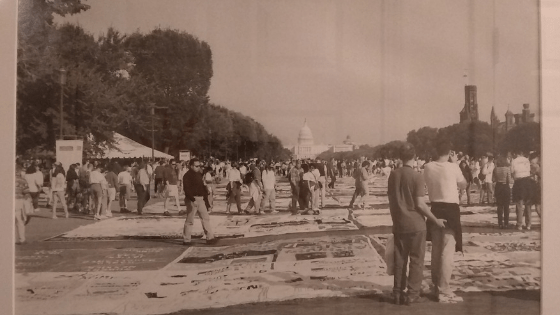
The Picture I Didn’t Hang

This World AIDS Day, I am moved by an image I walk by every day in my home, and an opportunity I took way too long to realize.

The photo shows a gay couple in the foreground of the AIDS quilt with the Capital Building in the background. From the moment I first saw it, as a senior in high school in 1997, it thrummed with trauma and triumphant, hopeful love. It’s the kind of moment that my cousin, Miguel, has captured throughout his art career. I love him for it, and I loved receiving this framed print as a graduation present.

AIDS awareness was important to me in high school; I danced at the AIDS Dance-A-Thon, raised money, did charity walks, whatever my privilege and do-gooder instincts could come up with. It was the 90s, and the wave of terror over contracting AIDS from toilet seats and casual touch had passed. But the movie Philadelphia and the Broadway show Rent figured prominently in my high school experience, and we looked for whatever ways we could cut against the still prevalent stigmas and trauma of the AIDS epidemic.

As I packed up my things for my college dorm room, however, I failed to stand up to my own fears of stigma. The piece clearly featured a gay couple; what if, by having it in my room, new acquaintances assumed that I, too, was gay? My romantic life being pretty limited already, I feared this possibility more than I would ever have admitted at the time (and more than I would like to admit now). I discreetly left it behind, tucked into a closet; I promised myself that I would find space for it by second semester.

Nearly twenty years later, I cleaned my childhood room once again (this time looking into every last crevice), and rediscovered my photo, still tucked in that corner. It still makes my heart pound with heartache and hope — that time, my view was laced with guilt as well.

How had this beautiful piece sat silently all these years?

I showed the piece to my husband, who loved it, but was confused by the strength of my desire to hang it up.

We found a place, right in our hallway, where I pass it every day. It is not only a reminder of that moment; it is a reminder to me, to stand up, speak out, and never let causes I care about take a back seat to my fears of creating discomfort (for myself or others). It is art inspiring me to action, even if it is 20 years late.

Better late than never.

So here, too is a belated message: Thank you, Miguel, for your artistry, and to you and Marilyn for showing me how it is done. I hope that, if nothing else, our home is always full of art that points us toward a better world.


Your Choice: Words that Change Everything or Mean Nothing

As a writer, words are my favorite thing, the basic building blocks of everything good. Words are the means by which stories happen, by which important ideas are shared, by which progress is made.

But over this last Martin Luther King, Jr. Day, I struggled to balance the all-importance of words with their utter lack of meaning.

We saw MLK quotes thrown about like confetti on Monday, some complemented by individual intent and consistent action, others just a cut and paste exercise in self-soothing on social media. The same words, deeply meaningful when spoken by one of our nation’s great leaders, but repurposed with varying levels of authenticity.

As a lover of words, it pains me so much when words are meaningless.

We do a disservice to ourselves and everyone around us when we toss out words like fluff, with nothing to anchor them in our actions.

Getting someone to take the time to read anyone’s words is tough, and we need to honor that. We need to take time with our words and match them to our intentions. Because whether we cheapen them, deny their power, or inflate our egos with them, words have more meaning than we allow ourselves to recognize.

Life is too short to waste your words or worry about anyone else’s empty blather. Let’s make sure that we nurture our words into action, and that we live them in the same way that MLK did.

Because after all, the words of individual people make movements — but only when they come with meaning, intention and action.

Layer It On

Art is a progressive act. No matter how angry or dark the subject, the act of creating and expressing is by nature optimistic, a call for connection and a search for understanding.

What’s especially exciting to me lately, then, is the layering of interpretations that can take place, as an original production gets remade, or dancers choreograph to a new song, or a book gets adapted for the screen. Expression on expression, the conversations between artists that span time periods, geographical space, and art forms.

One particularly entertaining example came last week, when U.S. figure skater Jason Brown performed to Hamilton’s The Room Where It Happened. Not only did he perform flawlessly for a full rink of fans, his performance made it to Lin-Manuel Miranda’s living room (Miranda wrote Hamilton). Surprise and delight travels well.

The other day I rewatched Joss Whedon’s version of Much Ado About Nothing, easily one of my favorite movies. Filmed in one house, over a weekend (so the legend goes), this production is visually gorgeous and also just the right combo of traditional and modern so that the audience will actually understand Shakespeare’s language. I repeat: when I watch this movie, I actually get what Shakespeare meant. The reinterpretation not only created a stunning production, but it also shone a light on Shakespeare’s timeless artistry. The layers work together to make both the original and the reinterpretation better.

Admittedly, maybe I’m thinking about layers so much simply because it’s freezing in New England and I’m wearing about twelve layers all the time. But I think it has more to do with the power that art provides for us to learn from one another and create in concert with those who came before and will come after us. A generational conversation about things that matter, in ways that we can understand.

Here’s the thing about interpretation, though: no one need wait to put their own spin on things. You do not need credentials to become part of the discussion (anyone who’s created dance routines to Whitney Houston can vouch for this). The discussion happens with every moment of appreciation and every act of production.

You are just as capable of interpreting the art that you see, of riffing off of a story that inspires you. As long as you are not ripping off someone else’s work, your engagement with the art is part of the process, and part of our progress as people.

For some people, engaging with art will inspire them to do something progressive in the political arena, to make phone calls to elected officials, volunteer in their community, or see someone’s experience a little differently. For others, it will inspire them to create more art.

Whatever your inspiration, whatever your medium, don’t shy away from engaging with the art around you. You just never know what it will inspire. Layer it on.


Can Solar Cars Make Us Happier?

There’s nothing better than when people talk about the things they love. It doesn’t matter if you understand a thing about their “thing,” because just seeing their faces light up is the point. You can literally watch someone drop a protective layer when they talk about their favorite hobby, artist, or experience. For me, it’s rejuvenating just to listen to them – and I don’t have to go anywhere or do anything myself. The lazy art lover’s way of enjoying creativity at play.

I learned this first in college, where one of my friends was head over heels in love with solar car racing. He spent days on end with his team, tinkering, creating, imagining new options. I never once, in all of our conversations, understood what was really happening. But the energy was like viral serotonin, dripping into my psyche and motivating me to work on my own thing.

Recently, I started reading about BOB. BOB is Pamela Paul’s Book of Books — a journal she’s kept of all the books she’s read since she was 17. My Life with Bob: Flawed Heroine Keeps Book of Books, Plot Ensues is her best-selling book about BOB. I haven’t even gotten through the first chapter, but the introduction itself left a mark for me. Paul waxes poetic about books — what they have meant to her, how they have marked key points in her life and concurrently shaped those same milestones. This New York Times Book Review editor manages to put into words what books have meant to her. Regardless of the ensuing plot that her book’s title promises, this homage to reading was worth it all on its own.

As we struggle through tough times, it strikes me that we should spend more time talking about the things we love. Not just doing or partaking in the things we love, but telling others why we love those things, trying to put the magic into words and share.

Sharing our joy will take us far right now. And it doesn’t require that we take days off, or have extra spending cash, or have access to a fancy exhibition or concert. To talk about what we love, all we need is some time and a listening partner. The listener might even benefit more from the experience than the sharer.

No matter how nutty your passion may seem (the nutty passions are the most fun!), please share the things you love. There is so much beauty in this world, and so much that we each don’t get to see. Let’s make sure that we celebrate the things that make us happiest, and give the gift of listening.

It sure as hell beats another hour of CNN. And who knows, you might just discover something new to love.