Flex the Imagination

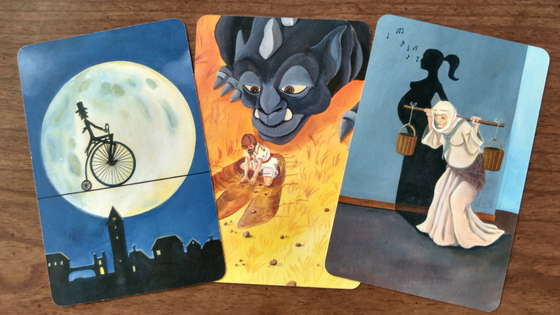
Dixit is a board game, but I treat it like a stroll for the imagination. The image includes three of my favorite cards, hard to pick out of the huge stack of equally fascinating mini artworks. Some are disturbing, others whimsical. Some are entirely up to interpretation. I especially like the details that can add layer on layer of nuance if you take the time to notice.

I use the cards as writing prompts, picking randomly from the deck. It’s like a strange little art gallery right at my fingertips. Turns my imagination into silly putty as I stretch to keep up with each little card. Quite a workout.

Even board games can be a source for creativity, a spark for more art. And isn’t that what makes art so amazing?


Wonder Full

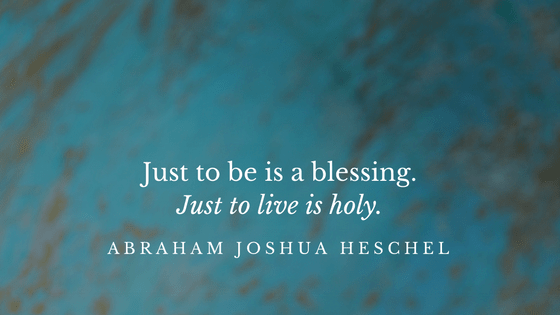
‘Tis the season of overwhelm. So I reach for grounding. One place I consistently find it is in the words of Abraham Joshua Heschel.

Heschel was a Jewish theologian and philosopher who escaped the Holocaust, helped in the movement to free Soviet Jews, and played a large role in the Civil Rights movement. He famously marched on Selma alongside Rev. Dr. Martin Luther King, Jr. As a person, he sounds amazing. As a philosopher, he speaks directly to me.

Here are just a few quotes that simultaneously ground and inspire me.

“Our goal should be to live life in radical amazement. ….get up in the morning and look at the world in a way that takes nothing for granted. Everything is phenomenal; everything is incredible; never treat life casually. To be spiritual is to be amazed.”

“The primary purpose of prayer is not to make requests. The primary purpose is to praise, to sing, to chant. Because the essence of prayer is a song, and man cannot live without a song.

Prayer may not save us. But prayer may make us worthy of being saved.”

“Remember that there is meaning beyond absurdity. Know that every deed counts, that every word is power…Above all, remember that you must build your life as if it were a work of art.”
Every deed counts. The world is full of wonder, if we see it that way. We can build our lives as if they were a work of art — with compassion, amazement, and meaning.
Yes, I can see a path forward if I can stay grounded in this.

What Do We Know?

Alicia Keys’ latest album, Here, came out a couple weeks before the election. Listening then, I loved it. Listening now, I am grateful for it. It’s beautiful, stripped down to its bones, and just what we need.

My favorite song is More than We Know, which I have been known to play on a loop. It’s not an anthem a la Kelly Clarkson or Katy Perry, but it’s my anthem right now.

When Wine Speaks

Amor Towles has the kind of name I would expect from a masterful novelist, distinguished and full of gravitas. With just two novels to date (Rules of Civility and most recently A Gentleman in Moscow), he’s not nearly as prolific as I would like. But every word is worth it; both novels rank among my all-time favorites.

Towles writes with a timeless, classic flair that places both novels in context of a long lineage of greats. A Gentleman in Moscow,  for instance, references the great Russian novelists in style, plot and tone – all with a nice fluidity and readability that caters to even the most distracted Kindle reader (at least, as compared to Tolstoy or Dostoevsky!).

Gentleman is the story of a man sentenced to house arrest in a hotel during the Bolshevik revolution, who manages to create a fulfilling, complex life despite his confinement. The novel never wallows in despair, rather basking in the beauty of moments large and small. The prose reads like a soothing bubble bath. I couldn’t get enough.

Early in the story, our gentleman finds himself in the hotel wine cellar, where all the labels have been removed. The passage that follows embodies the book’s powerful prose:

“Picking up one at random, he reflected how perfectly the curve of the glass fit in the palm of his hand, how perfectly its volume weighed upon the arm. But inside? Inside this dark green glass what exactly? A Chardonnay to complement a Camembert? A Sauvignon Blanc to go with a chevre?

“Whichever wine was within, it was decidedly not identical to its neighbors. On the contrary, the contents of the bottle in his hand was the product of a history as unique and complex as that of a nation, or a man. In its color, aroma, and taste, it would certainly express the idiosyncratic geology and prevailing climate of its home terrain. But in addition, it would express all the natural phenomena of its vintage. In a sip, it would evoke the timing of that winter’s thaw, the extent of that summer’s rain, the prevailing winds, and the frequency of clouds.

“Yes, a bottle of wine was the ultimate distillation of time and place; a poetic expression of individuality itself. Yet here it was, cast back into the sea of anonymity, that realm of averages and unknowns.”

Have you ever heard a bottle of wine more beautifully described? And if Towles can evoke all of that with a wine bottle, what can he do with a full novel? His prose gave me hope that there is always beauty even in adversity, and that community will get us through anything.

Art – in this case, a novel – did its job once again, this time shoring me up through its beauty and depth.

What have you read that inspired you lately? Let me know in the comments.



Safety Pins

In November, safety pins found a new purpose as a social justice tool. They had already captured the imagination of artist Tamiko Kawata. Kawata uses safety pins as medium. It’s got me thinking about them differently and appreciating their beauty. And isn’t that what art is all about?

Check her out at: http://www.browngrotta.com/Pages/kawata.php