Delicate vs. Fragile

Thanksgiving can begin an emotional holiday rollercoaster — joy, hope, sorrow, disappointment, overwhelm, gratitude. Sometimes they come all at once, like a deluge. Sometimes, we let the busy-ness overtake us and we numb ourselves to all of the above.

Sometimes, in those quiet moments, we can feel fragile. At the mercy of our emotions, we can be quick to anger, easy to upset, or hard to calm.

The flipside of fragile, though, might not be strong. What if the flipside of fragile were delicate?

What if delicate were beautiful, and what if we could treat our own delicacy as awe-inspiring in its own right?

Art might be a good place to explore this idea.

Delicacy, in art, is so gorgeous that it makes me gasp, sucking in my breath so as not to disturb anything. It is full of details, carefully considered, not a line or stroke out of place. Delicate art is concentration embodied, complexity condensed into something so fine and wondrous that you almost dare not touch it.

In China, street vendors offer to write your name on a grain of rice, and it seems like magic. Then you see whole landscapes etched on one single grain, and your whole sense of scale gets redefined. See what I mean.

In Vietnam, grains of rice get arranged to create paintings, every piece carefully placed to create a magical whole. Check these out.

In India, centuries of miniature paintings have created masterpieces in every inch. See this beautifully curated collection.

A British artist creates sculptures in the eye of a needle, causing us to look deeper at everything around us.

Even on a daily walk, the silvery weave of a spider web, or the intricate lace of a tree leaf reminds us that things can be at once delicate and strong.

Art embraces delicacy. What would happen if we did, too?
Chrysanthemums

Having been unable to keep even the most basic green plants alive, flowers feel like alien beings, beautiful and untouchable by the likes of me. But October in New England finds every exterior display outfitted with at least two mums, preferably of a deep red, orange or yellow flavor.

Mums are not merely significant in their plant version, as with many flowers. For as long as there have been pretty plants, we have wanted to paint, press or carve them for posterity. Mums, it turns out, have been the staple of many cultures. Long before the pumpkin patch, they were part of many global traditions, especially in China and Japan, even signifying death in Europe for a time.

So, the chrysanthemum has a lot in common with other time-tested characters:

  • One of its best characteristics, its resilience, is also what got it into trouble for a time. Chrysanthemums are known as fall flowers because they can withstand the change of seasons and drop in temperatures. They look beautiful even when the crisp air comes sweeping through. This is also the reason chrysanthemums came to symbolize death: they were so hardy that they became the flower of choice for gravesides and funerals. Their very toughness, then, made them extremely unpopular for a while — because they were associated with death.
  • It is part of an influential group. In Chinese art, the chrysanthemum is one of the “Four Gentlemen,” which also includes the plum blossom, the orchid, and bamboo. Each one represents one of the seasons. Can you guess the chrysanthemum season? Yup. Fall.
  • It knows what it does best. No matter where in the world it appears, the chrysanthemum is a symbol of fall. In Australia, it is in fact the favorite flower for Mothers’ Day – in part because Mothers’ Day lands in the middle of fall.
  • It means more than meets the eye. Because it’s tough, it lasts, and it doesn’t wilt under pressure, it is a symbol of endurance and long-lasting relationships. It also appears in medicine, teas, soups and more.

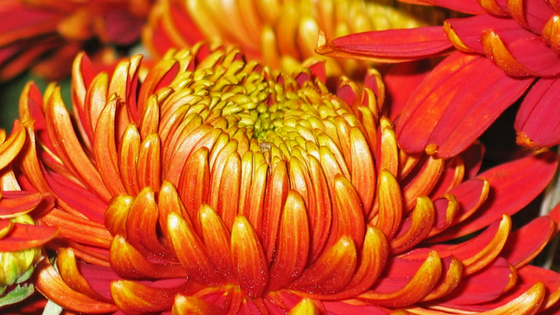
I love the geometry of the petals, the brilliance of the colors, and the immense number of blossoms in one little plant. I love that they are hardy, strong and beautiful, unlikely to give in under pressure of cold, wind or weather.

I like knowing more than meets the eye about most things, and chrysanthemum are no different. Though you likely won’t see one gracing my stoop, I will be able to find you amazing images from across the centuries. Each from different cultures, based on different assumptions. But the same tough plant, standing its ground no matter where it’s planted.

What is part of your every day life that you could see differently today?

Slather It On

It gets worse – the news, our realities, the dangers to people we love and people we have never met. Those who were once marginalized are now targeted; those who were once excluded are now directly in the floodlights of hate, violence and policy-level discrimination.

The world feels like the harshest of brilliant lights, 2017 a long trek through the desert. And like any journey, it is no safer to turn around than to continue forward (aside from the fact that it’s impossible to go back, I get that too). So I’m working to slather on the artistic equivalent of SPF1000 sunscreen: a good, thick layer of art, relentlessly reapplied. Such that I may go back out into the trek, at least slightly protected.

The art that builds us up might be in a museum or gallery, but it might not. It might be created by a famous historical figure, but maybe it’s done by your neighbor with a special passion. The definitions should be broad, underscored by the key takeaway: does it work for you?

Here are three things that are making up my sunscreen today:

Pumpkin Art – Around the world this month, harvest festivals will inspire all kinds of cool displays. Some go for the creepy and ghoulish, the cute and clever, the simple and classic. The one I saw recently in photos? Jaw-dropping. I don’t know Kevin or his neighbor(s) but his thread on Twitter stopped me in my tracks. Man-oh-man, this must be incredible to see in person: Pumpkin Dragon!

Perfectly Delightful Story – I just finished Eleanor Oliphant is Completely Fine, an amazing novel that is equal parts entertaining, delightful, tragic and uplifting. I almost didn’t make it in the beginning, because I was reading another book with an extremely quirky main character, and I didn’t know if I could handle two. So glad I did, though. Eleanor’s frankness, intense skills of observation, and utter lack of life experience make her instantly likeable and interesting. She’s that classic person we care and worry about, hoping she’ll make out okay. And she does far more than that.  As someone who writes novels, I was impressed by the ease with which the author, Gail Honeyman, molds a complex story into just the right mix of good, bad, ugly and redemptive. Could not put it down, and I miss Eleanor already.

Soothing Woodwork – My dad introduced me to the master work of Sam Maloof, famous for his wooden rocking chairs and furniture. Maloof created pieces that look like peacefulness embodied. Smooth, always madly respectful of the natural grains of the wood he chose, with gentle curves that look like they might melt if you’re not careful. They are far too expensive for most anyone to own, and sadly, Maloof passed away. But just knowing these exist, and appreciating their artisty, makes me happy.  The Smithsonian article has a few photos.

How do you bolster yourself in these harsh days? What artistry speaks to you? Whatever that is, slather it on — the more, the better.


Off Days

Thank goodness that others speak when I am speechless.

Thank goodness that others act when I am overwhelmed.

Thank goodness that others fight when I am gathering the courage.

Thank goodness that others help when I can’t. quite. get. there.

I know I can’t rely on others to do it all, and that I must act. But for those days when I stumble, I am eternally grateful for those who keep going and encourage me to get right back up.

It’s an off day for me, but not for the people behind this important Kickstarter. Check out this incredible array of art, made by activist artists, that will be available in newspapers across the country on January 21st:

https://www.kickstarter.com/projects/amplifierfoundation/we-the-people-public-art-for-the-inauguration-and

Thank goodness for artists. And activists. And activist artists.

Wit and Whimsy

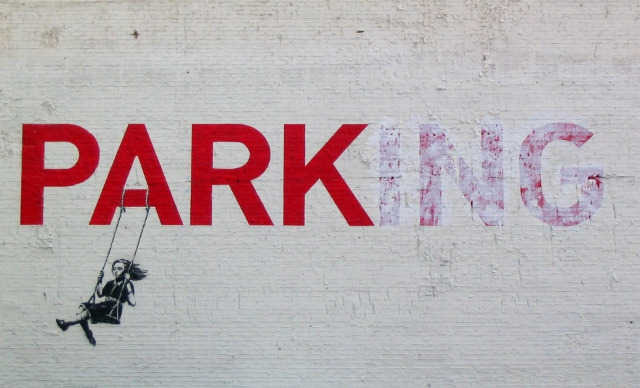
We took a photo of this mural in Downtown L.A. on one of our neighborhood walks, and I’ve framed it and toted it from office to office. It’s a red PARKING sign, with the last three letters faded and a young girl swinging from a swing that hangs off the “A.”

It’s one of those beautiful combinations of whimsy and deep message. I can picture myself in the swing, the wind in my hair as the swing reaches higher. Just by three faded letters, the artist reminds us that we can turn something practical into play without too much sacrifice.

I’ve interpreted it as a reminder to play, to enjoy life, to swing high sometimes.

Every once in a while, I wonder if I missed the real meaning of the piece. What if I completely missed the memo and have it all wrong?

Misinterpretation is a risk inherent in all art and its consumption. Every time we put something out there, it could be misunderstood. But what if it takes on new meaning? Is that okay? Can we be okay with putting art out that has a life of its own, that we can’t control?

Better to put it out there than to hold it close, afraid of what might happen to it when released into the world.

If you have a different interpretation for this mural, or any of the other pieces I discuss in this blog, please share. Because sticking to my own interpretations gets boring and I’d much rather hear from you!